April 2026
Natural language search
TL;DR The sourcing platform's filtering was thorough, but slow. Powerful filters and sorting tools are not necessarily quick, quite the opposite. To bridge the gap between browsing intent and result, I built a natural language input that translated to visible, editable filter state and shipped it in two weeks without dedicated engineers, turning an oft-repeated minute-long task into a seconds-long workflow.
The Gap
The sourcing platform gave buyers the whole carbon market in one place: tens of thousands of projects, over 40 data points each, all filterable and sortable. The filtering was thorough, and it was slow. Expressing what you wanted meant a long string of selections. Naturally voiced criteria like "Nature-based removal" isn't one filter; it's fifteen technology types and a few mechanisms combined into a commonly used category of projects. A buyer who knew exactly what they meant by it still spent 15+ clicks to put together a filter list they'd submit to find what they were looking for.
That cost everyone, whether it be the experts who knew what to look for (e.g. NBR CCP-labeled BeZero AA+ projects on an ICROA registry) or buyers who were intent on discovery and figuring things out (e.g. what are the best ocean-based projects out there). The filtering worked. It just made everyone slow, multiple times every day.
In 2026, a proper AI setup made it so a designer could see the gap, scope it, and pick it up, which I did.
Built it in two weeks
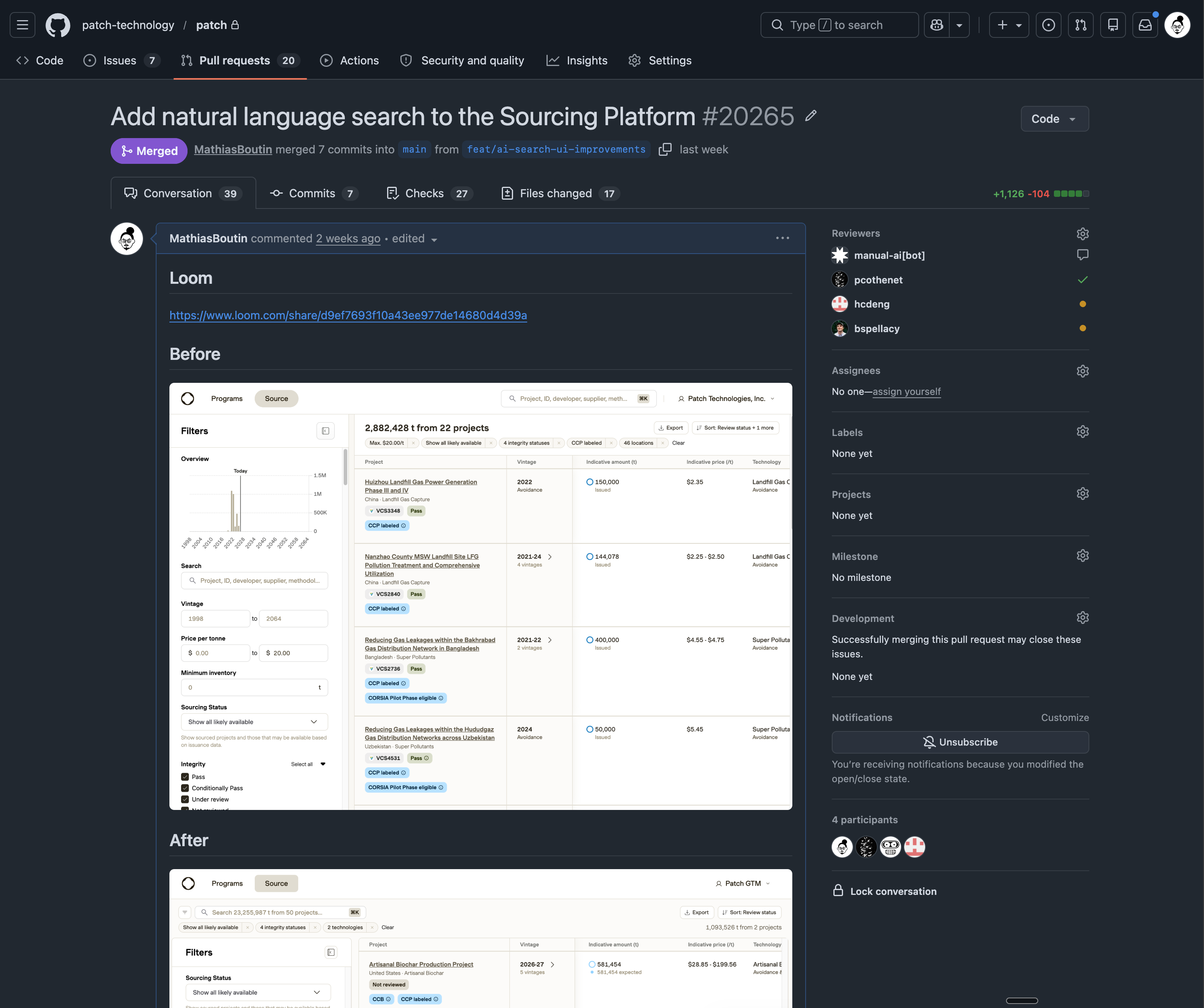
For this, I didn't build a chat interface. We had solid filtering and sorting functionality, and a set of structured data. What we needed was a probabilistic, natural language interpretation of a user's query that we could turn into deterministic results. Natural language in, a visible and editable set of filters out. You type what you're looking for, the AI translates it into filter state, and you see exactly what it did. It misinterpreted you? Or maybe you didn't query exactly as you intended? Not a problem, you can just adjust the filters directly. The AI simply lowers the cost of saying what you want. It doesn't take the decision away from you.
From some quick Figma mocks, to a locally working Cursor-built proof of concept with real project data, to a working PR in three days and shipped end to end in two weeks, this went from idea to prod with no roadmap item. The idea was clear and the build was cheap enough that overthinking it would have been the mistake. Engineers were invaluable to the process with their feedback, but otherwise could stay focused on higher priority roadmap items they were working on.
The experience was simple: type your natural language query into the search bar and a small Haiku agent, aware of the set of filters and sorting options available to it and knowledgeable about key terminology, interpreted the query and automatically applied, with visible feedback, a set of filters and sorting logic that met your criteria, that you could review and edit as needed, either with natural language again, or more traditional filter and sort patterns.
What it taught me
AI has collapsed the cost of trying. Worst case here was a week spent learning the idea didn't land, against a real build and real data. It also let me prototype against the actual dataset in days, which matters: search is hard to judge from mocks. You only see if it works when it's parsing real, messy data.
And a designer's leverage has changed. UX-first work like this at Patch used to be a roadmap item that competed for engineering time and lost most of the time. Now, it's a single designer's side project, built and shipped with a bit of support. The work that gets done is no longer limited to the work that gets prioritized.